Understanding the 4 Personality Types: A, B, C, and D

Each person is a unique combination of four personality types. Over the centuries, these basic categories have gone by several names and designations, but for our purposes, they're known as the director, the socializer, the thinker, and the supporter. As shorthand, though, we refer to those types of personality as A, B, C, and D, respectively.
Learning how to identify people by personality type can bring a higher level of understanding to interpersonal relationships and team building, especially for employers looking for ways to avoid bad hires and reduce turnover. Indeed, a good personality test may be the most valuable tool in a hiring manager's toolbox.
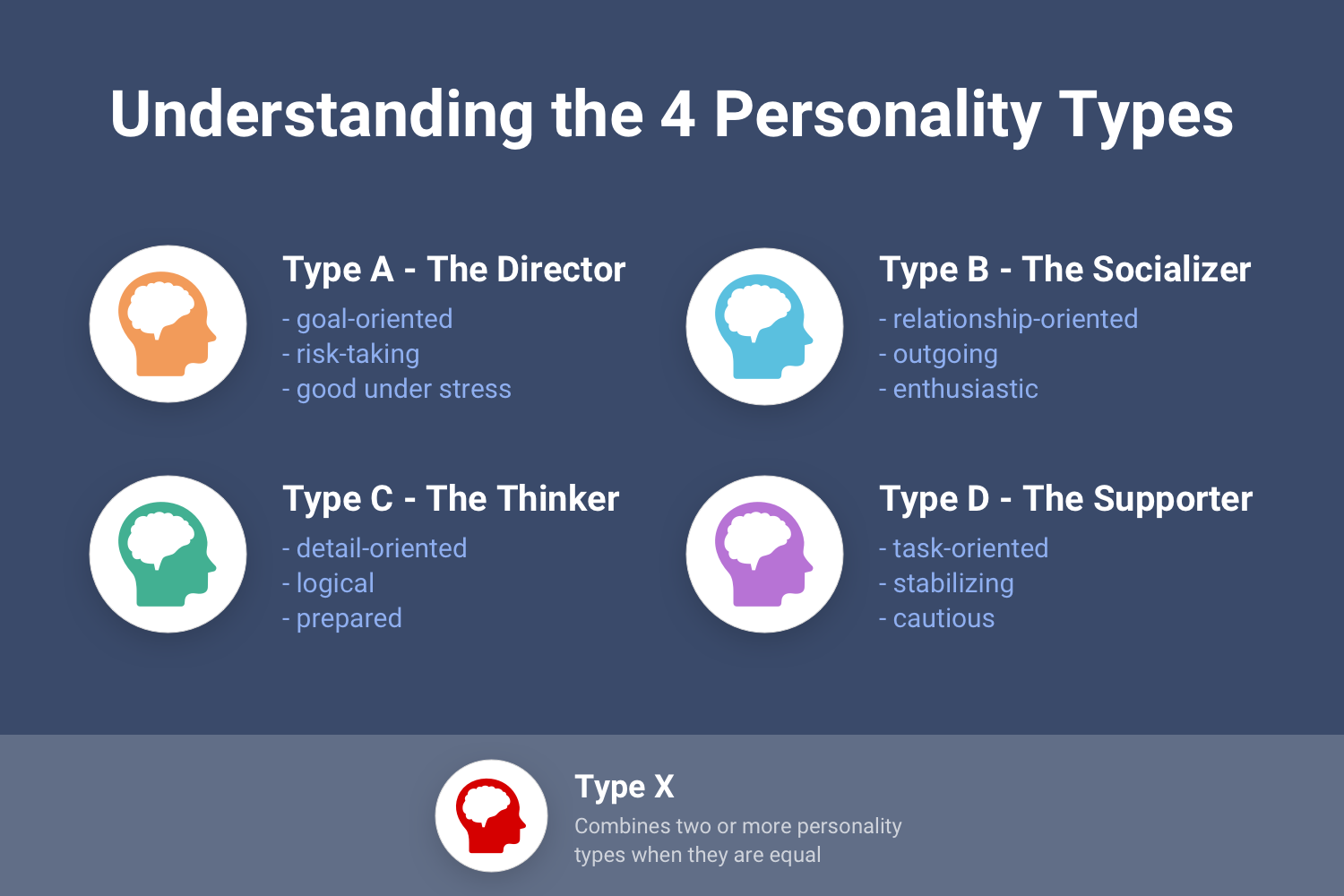
The history of the 4 basic temperaments
The origins of the four personality types can be traced back more than 2,000 years to the "father of medicine,” Hippocrates, in ancient Greece.
Hippocrates named the four personality types after specific body fluids: Choleric, Melancholic, Phlegmatic and Sanguine. These four temperaments are rooted in the humoral theory of medicine and have persisted through history under different interpretations and adaptations.
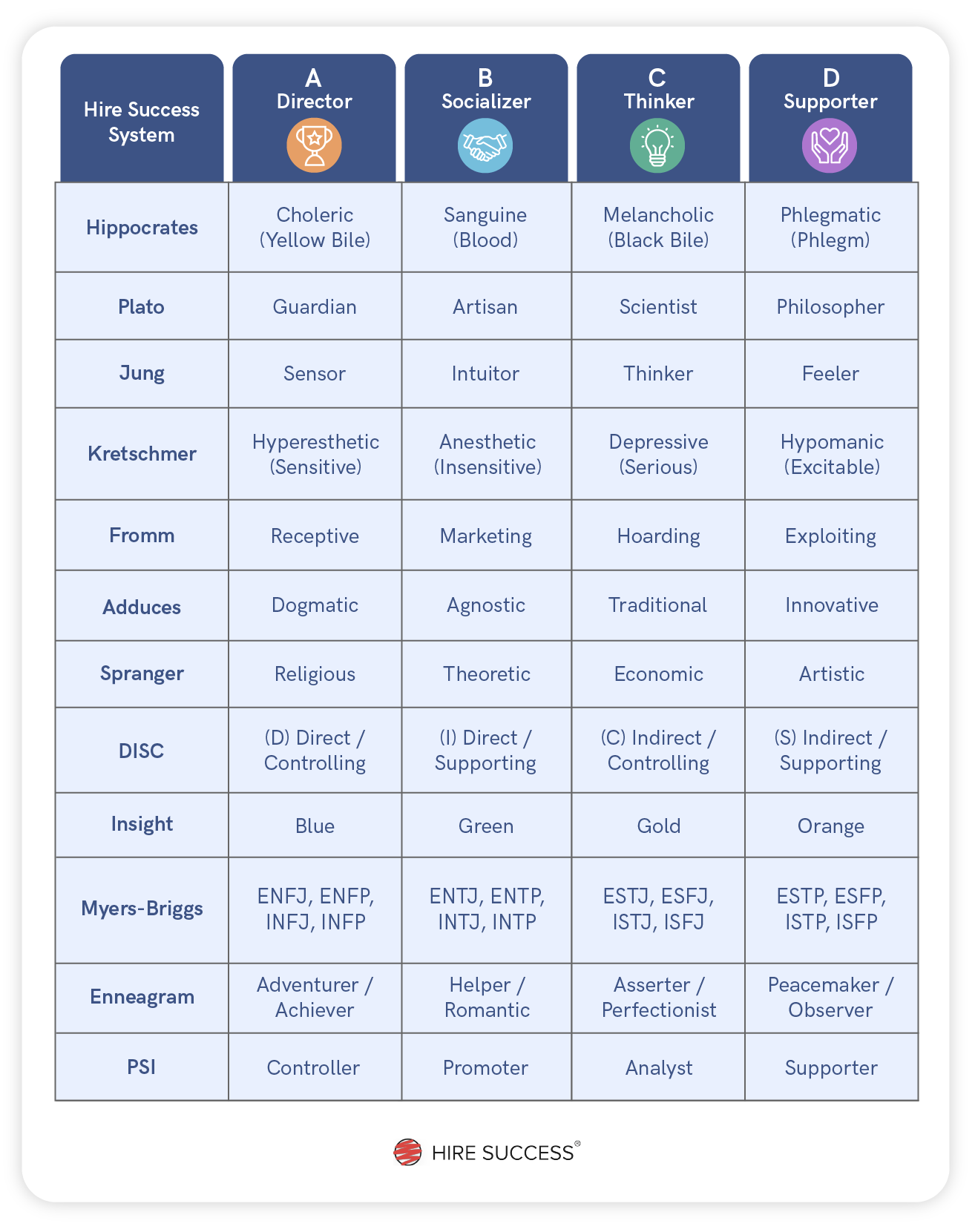
The Hire Success® System builds on this historical foundation, with the belief that each person is a unique combination of all four personality types. It gives the four types a simple A-D nomenclature to avoid assigning descriptive labels to people For comparative purposes, please refer to the table below to see a cross-reference between the Hire Success® Personality Types ("A", "B", "C" and "D") and other common personality tests and theories. If you're familiar with any of these other tests, it should make understanding the Hire Success® System even easier.
What is a Type A personality?
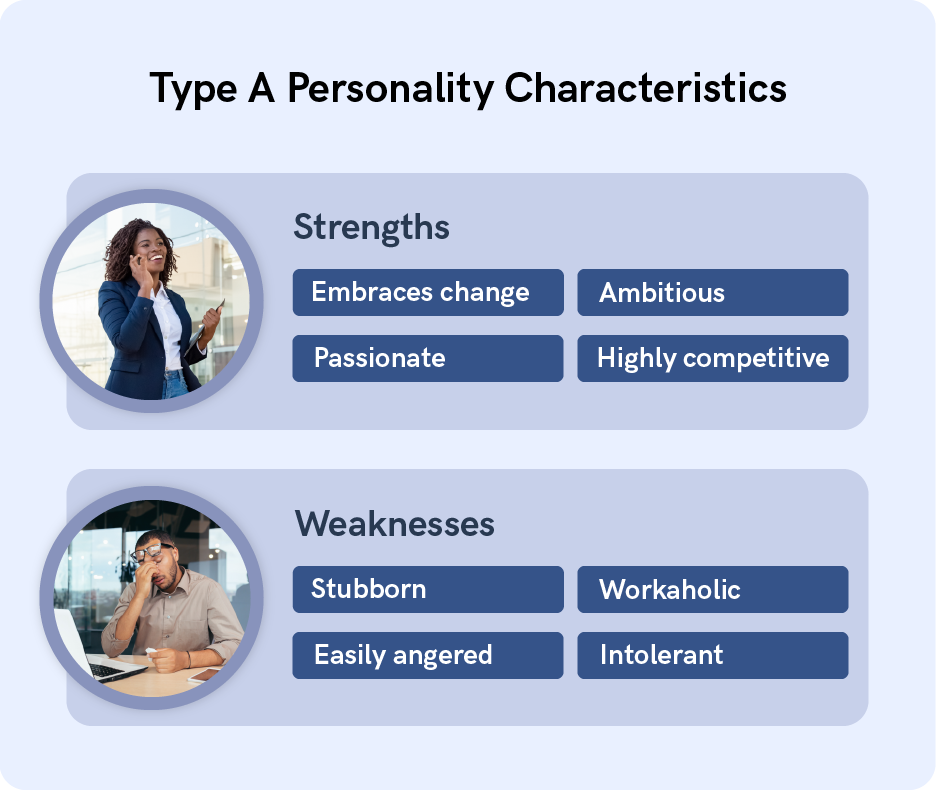
Type A personalities like to be in control of every aspect of their lives. These individuals are characterized by their competitiveness, though they often lack attention to detail and prefer to delegate tasks to others. Type A personalities are also results-driven, goal-oriented, and practical in their solutions.
Type A personality characteristics
While some Type A personality traits vary from person to person, certain traits are common. The best example of a Type A personality is someone who is:
- Take-charge and highly competitive
- Fast-paced and impatient
- Entrepreneurial, workaholic
- Embraces change
- Ambitious
- Works well independently
- Passionate but short-fused
- Demands maximum freedom
- Dominant and stubborn
- Multitasking
What are other names for the Type A personality?
Here are some other names for and best examples of Type A personalities.
| Personality Tests & Approaches | Type A Personality Name |
|---|---|
| The Hire Success® System | Director |
| Hippocrates | Choleric (bodily humor: yellow bile) |
| Plato | Guardian |
| Jung | Sensor |
| DISC | D; Direct/Controlling |
| Insight | Blue |
| Myers-Briggs | ESTJ, ENTJ, ENFP |
| Enneagram | Adventurer/Achiever |
| PSI | Controller |
| Biblical character | Paul |
| Cartoon/comic characters | Lucy (from Peanuts) / Rabbit (from Winnie the Pooh) |
How to test Type A personality
A Hire Success® Type A personality test assesses behavioral characteristics. You'll get an idea of how well positive aspects like drive, perfectionism and ability to work independently balance negatives like impatience, hostility and low empathy. The test is quick, easy and even fun for employees-and gives you valuable hiring and managing insights.
Type A personality at work
When it comes to work personality types, employees with Type A personalities can typically be identified by the following traits:
- Goal-oriented
- Risk-taking
- Good under stress
- Works well independently
- Direct management style
- Good delegation skills
- Good administrative skills
- Workaholic
Type A personalities don't like a lot of restraints or restrictions placed on them. Instead, they prefer to work independently and set their own schedules. Since they tend to be workaholics, it's not unusual to see them put in whatever time and effort it takes to accomplish their goals. They may seem impatient at times, especially if they believe someone is spending too much time going over details with them or impeding their stride.
Don't be surprised to see this personality type in a supervisory position or management. Having an entrepreneurial streak, they may be a business owner or strive to own their own business someday. Type A personalities are confident and not easily discouraged.
Pros and cons of hiring Type A personality
If a Type A personality sees their day-to-day job as routine or repetitive, they'll get bored easily and won't enjoy the work. They'll want others to view them as tough in these situations, but internally they may be miserable if the job is too routine. Dominant in nature, Type A personalities will do whatever is necessary to prevent themselves from falling into patterns or routines and seek freedom instead. They'll also be very dissatisfied if they believe someone is trying to manipulate them.
A Type A personality may not be very good at recognizing coworker's feelings and needs. They're extremely focused on achieving their goals and may not notice. If you're looking for someone who works well under pressure and seems to excel in high-stress situations, the Type A personality is the best pick.
How to deal with Type A personality at work
Managing employees with type A personality traits at work is a balance. They can be valuable in terms of problem solving and productivity, but when unmanaged, can be disruptive. Managing motivations and situations is the key.
What motivates a Type A personality?
- Money
- Opportunity
- Freedom
- Favorable risk-reward ratio
- Challenges
- Urgency
- Success
- Leadership
What are some common words or phrases that motivate or grab the attention of the Type A personality?
- "Let's get it done."
- Fast
- Results
- Immediate/today/now
- The bottom line
- "What do you think about ___?"
- "The best (newest, cutting-edge, etc.)"
- Take the challenge
- Great return on investment
What are the turnoffs, dislikes, and fears of the Type A personality?
- Touchy-feely things
- Long explanations or descriptions
- Explaining things in emotional terms or more than once to the same person
- Looking vulnerable
- Falling into routines
- Being manipulated
- Losing
Which jobs attract a Type A personality?
The best careers for Type A personality include:
- President/CEO
- General contractor
- Salesperson or sales manager
- Business owner
- Politician
- Entrepreneur
- Police/military officer
- Manager
- Executive
Type A vs. Type B personality
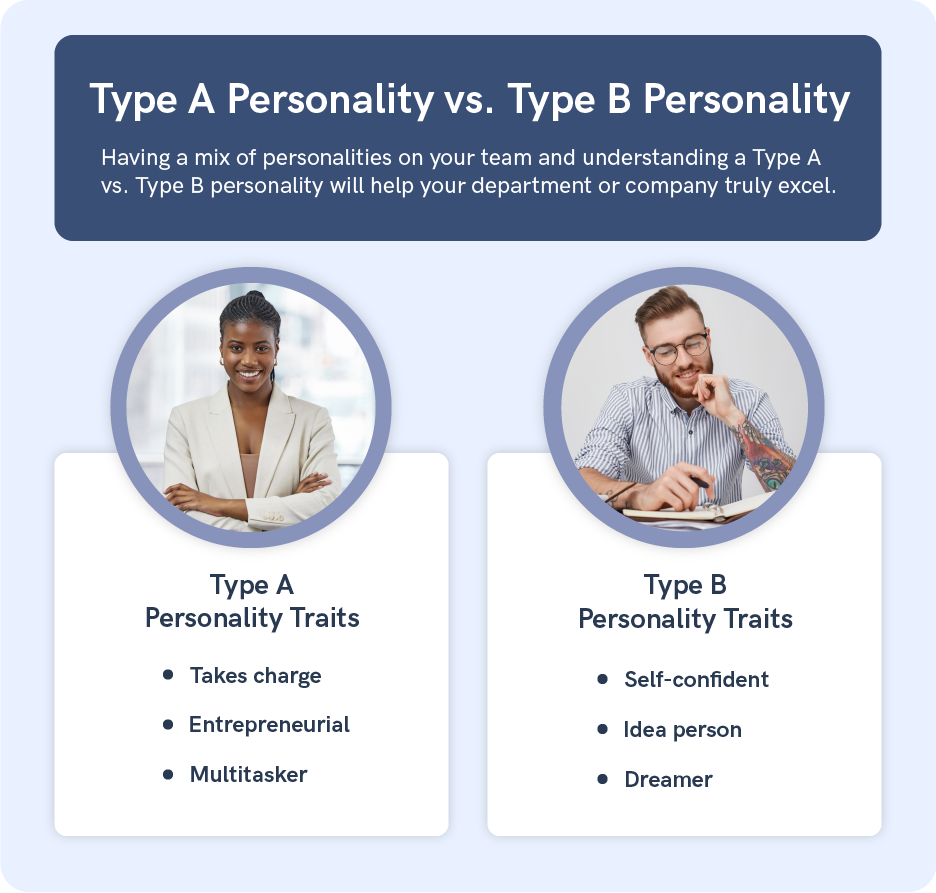
Having a mix of personalities on your team and ensuring that they mesh will help your department or company truly excel. Understanding a Type A vs. Type B personality will help you get the balance right between these two working styles.
Pair goal-oriented, future-thinking Type A people with agreeable and present-focused Type Bs.
Controlling Type As can be complimented by Type Bs who work on forging strong relationships.
Self-motivated Type As can keep Type Bs, who are driven by others on the team, focused in the right direction.
It helps to understand both personality types when balancing out teams. Here is a deep dive into what a Type B personality is.
What is a Type B personality?
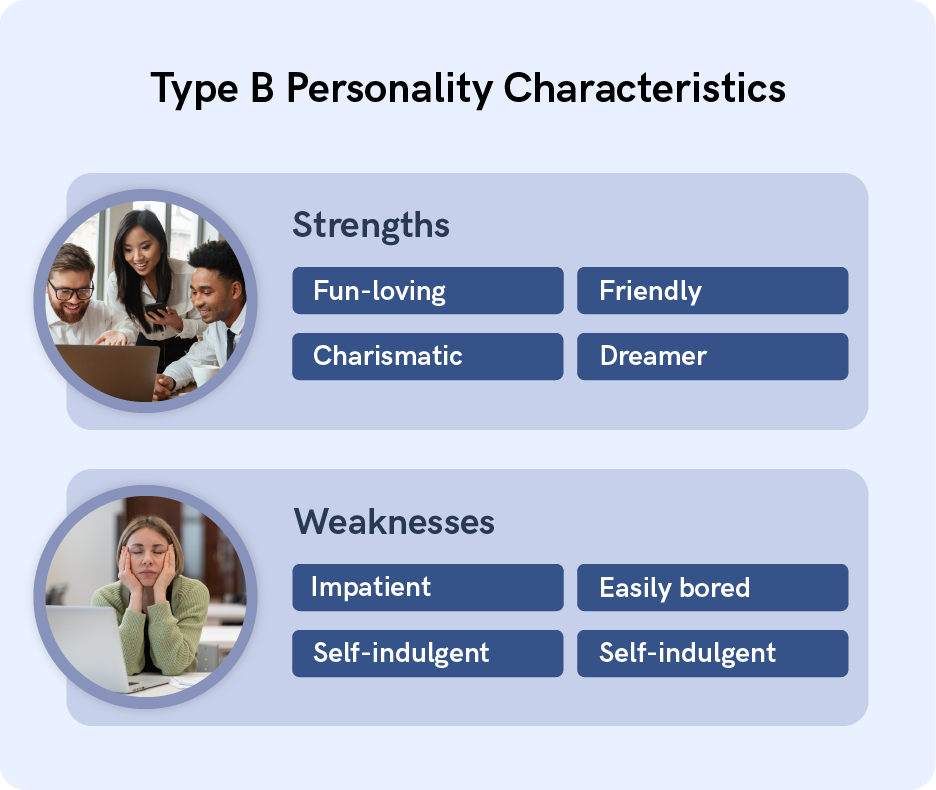
The Type B personality is a very easygoing, flexible, and laid-back individual who enjoys the company of others and forming new relationships. Type B personalities are characterized by their care-free approach to life and their tendency to shy away from conflict or stressful situations.
Type B personality traits
Like Type A personalities, Type B personality characteristics can also vary by individual. The best example of Type B personality is someone who is:
- Enthusiastic and fun-loving
- Persuasive
- Friendly
- Charismatic and confident
- Idea person, dreamer
- Short attention span
- Motivator
- Spontaneous and impulsive
- Procrastinator
What are other names for the Type B personality?
| Personality Tests & Approaches | Type B Personality Name |
|---|---|
| The Hire Success® System | Socializer |
| Hippocrates | Sanguine (bodily humor: blood) |
| Plato | Artisan |
| Jung | Intuitor |
| DISC | I; direct/supporting |
| Insight | Green |
| Myers-Briggs | ENTJ, ENTP, INTJ, INTP |
| Enneagram | Helper/romantic |
| PSI | Promoter |
| Biblical character | Peter |
| Cartoon/comic characters | Snoopy (from Peanuts) / Tigger (from Winnie the Pooh) |
How to test Type B personality
The Hire Success® Type B personality test helps you assess how a given person will fit within your culture and teams. While you may make you feel comfortable surrounding yourself with people like you, it's better to have a good balance of personalities on your team.
This test lets you find Type B personality traits like being easy-going, optimistic, creative and a team player with weaknesses like being impulsive, needy of validation, and procrastinating. The test is easy and gives you valuable insights for hiring and managing potential team members.
Type B personality at work
Employees with Type B personalities can typically be identified by the following traits:
- Relationship-oriented
- Outgoing
- Enthusiastic
- Doesn't finish what was started
- May try to do too much at once
- Easily bored
- Easily liked by most people
Type B personalities love to talk about themselves. Some may view that as self-centered, but a Type B's real motivation is to be liked. For an extreme example, Bette Midler in the movie Beaches invited an old friend up to see her lavish apartment and told her about her great success. She said to the friend: "Enough about me. Let's talk about you. So, what do you think of me?"
The Type B personality's biggest fear is being humiliated in public, since that might make many people disapprove of them. It could be traumatic for them. The B personality doesn't want to appear unattractive or unsuccessful either, so they'll hide any weakness.
Pros and cons of hiring Type B personality
Some of the strengths you can count on from the Type B personality are their enthusiasm, outgoing behavior, friendliness, and their ability to persuade even the most skeptical of people. They tend to be dreamers and can often turn those dreams into very practical ideas in the workplace. Type B personalities are spontaneous and use their quick wit and humor to make people like them. They aren't very good about hiding their own feelings either, so if they're hurt or disappointed, you'll probably be able to read it in their mannerisms and overall disposition.
Some of the natural weaknesses associated with the Type B personality include being impatience, a short attention span, and not being very detail-oriented. In business, Type B personalities may tend to over-socialize and not spend as much time doing their work because they strive for social interaction. During the hiring process, they may be inclined toward unstructured, rambling interviews rather than structured ones, and bad interviews can lead to bad hires. Despite their natural tendency, many Type B personalities have learned to keep their counterproductive impulses in check while benefiting from the positives.
How to deal with Type B personality at work
Put Type B people on teams and spend time working with them directly. Avoid putting them in a solitary position with little interaction because they're most effective in collaborative situations. They're also ideal for positions where they must interact with customers or suppliers and thrive in social settings.
What motivates a Type B personality?
- Public recognition
- Awards, plaques, certificates
- Having picture taken with celebrities
- Succeeding, especially beyond peers
- Being the center of attention, public speaker, director, etc.
- Acceptance
- The latest styles and/or trends
What are some common words or phrases that motivate or grab the attention of the Type B personality?
- "You look great."
- "You're the best ____."
- "People love you."
- "This will be fun."
- Entertaining
What are the turnoffs, dislikes, and fears of the Type B personality?
- Public humiliation
- Being unappreciated
- Appearing uninvolved
- Nonsocial types
- Appearing unattractive
- People and things that distract attention
- Appearing unsuccessful
- Appearing unacceptable
The best careers for Type B personality include:
- Public relations
- Salesperson
- Entertainment
- Personnel interviewer
- Professional host(ess)
- Politician
- Recreation director
- Party planner
- Customer service/relations
What is a Type C personality?
Type C personalities are detail-oriented individuals who prioritize logic and rational thinking when making decisions. Type C personalities are analytical and objective, relying on research and facts rather than opinions based on emotion.
Type C personality characteristics
Type C personalities come with considerable variations, however, the best example of a Type C personality is someone who is:
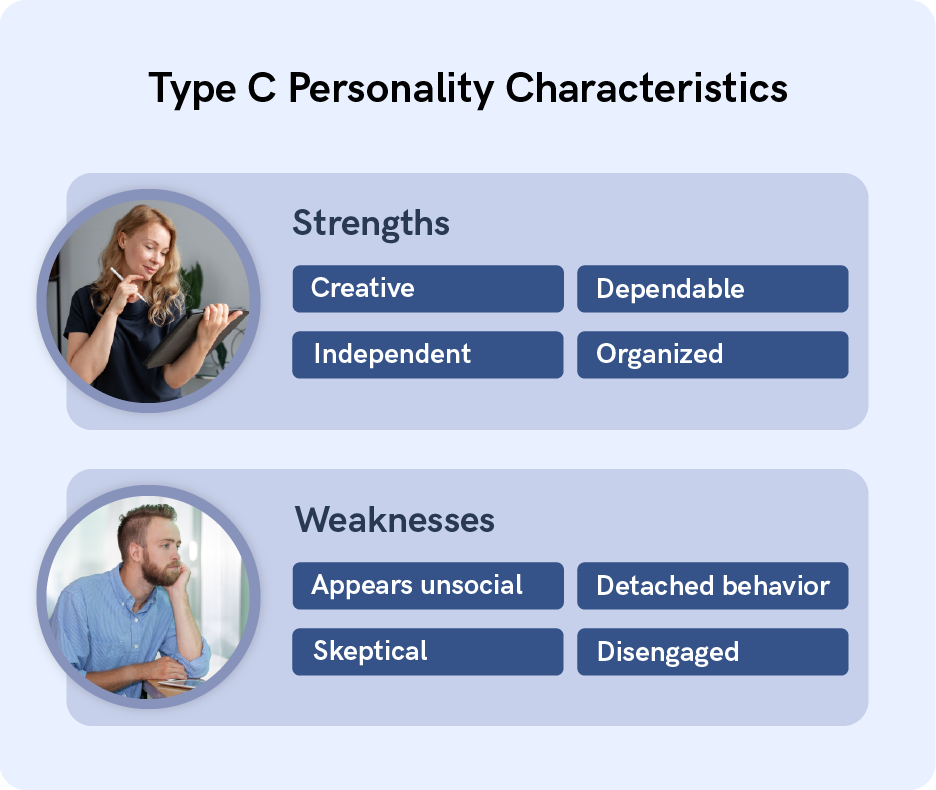
- Accuracy and detail-oriented
- Creative
- Dependable
- Skeptical
- Independent and can appear anti-social
- Lawful
- Organized
- Analytical and critical
- Worried about progress
- Detached and disengaged
What are other names for the Type C personality?
| Personality Tests & Approaches | Type C Personality Name |
|---|---|
| The Hire Success® System | Thinker |
| Hippocrates | Melancholic (bodily humor: black bile) |
| Plato | Scientist |
| Jung | Thinker |
| DISC | C; indirect/controlling |
| Insight | Gold |
| Myers-Briggs | ESTJ, ESFJ, ISTJ, ISFJ |
| Enneagram | Asserter/perfectionist |
| PSI | Analyst |
| Biblical character | Moses |
| Cartoon/comic characters | Linus (from Peanuts) / Eeyore (from Winnie the Pooh) |
How to test Type C personality
The Hire Success® Type C personality test helps you find people with traits in this cluster. You will be able to quickly assess the positives, like detail-oriented focus, ability to work alone, troubleshooting and planning skills. You will be able to manage the negatives like social inhibition, conflict avoidance and anxiety.
Type C personality at work
People with Type C personalities can typically be identified by the following traits:
- Detail-oriented
- Logical
- Prepared
- Likes to do things their own way
- Worry about progress
- May never have personal expectations met
- Quality control
Type C personalities tend to be quite controlling, both of themselves and others. They don't like things to get out of hand and may appear stoic because they don't really want themselves to display a lot of emotion. They're very outcome-driven and will be sticklers for following protocol.
They're careful, resourceful, and, above all, excellent thinkers who will look at all aspects of an issue before taking a stand. Once they take a stand on an issue, though, they'll have the facts to back it up, so anyone who challenges them better be prepared. If you have a Type C personality on your job candidate shortlist, you'll want to prepare some thoughtful interview questions if you don't want a carefully rehearsed response.
Pros and cons of hiring Type C personality
Type C personalities like their jobs to be clearly defined and want to know their expectations. Knowing those facts, they will be able to prioritize their tasks and see them through to completion.
In managerial roles, they're cautious and logical and require many details and facts before they make a decision. People who try to sell them something with emotion usually fail. The Type C personality would consider such an effort to be hype and would wonder what facts the other person is trying to hide.
In more public roles, Type C personalities will strive for originality, cleverness and uniqueness in all things. Because of their detailed orientation, they're meticulously prepared to defend their decisions against any possible objections. Many accountants and lawyers are Type C personalities. They're excellent for any job that requires creative thinking based on patience, facts and accuracy.
How to deal with Type C personality at work
Those with Type C personality traits can play valuable roles on your team. They're motivated to handle important tasks that require determination and an eye for detail. They're less comfortable in leadership positions and prefer to work alone.
What motivates a Type C personality?
- Control
- Opportunities to be independent and analytical
- Challenges
- Problem-solving
What are some common words or phrases that motivate or grab the attention of the Type C personality?
- Perfection
- "How does that work?"
- Quiet, solitude
- "Tell me more about ____."
What are the turnoffs, dislikes, and fears of the Type C personality?
- Uncontrolled emotions
- Irrational acts
- Indecision
- People who are self-centered, or self-aggrandizement
- Loss of control
- Being subject to control or supervision by people they don't trust or respect
- Distractions or distracting people
Which jobs attract a Type C personality?
The best careers for Type C personality include:
- Forecaster
- Troubleshooter
- Critic
- Investigator (police, crime scene, private, etc.)
- Engineer
- Technical support
- Research scientist
- Game designer
- Data analyst
- Pilot
- Programmer/analyst
- Artist
- Actuary
- Musician
- Accountant/auditor
- Inventor
What is a Type D personality?
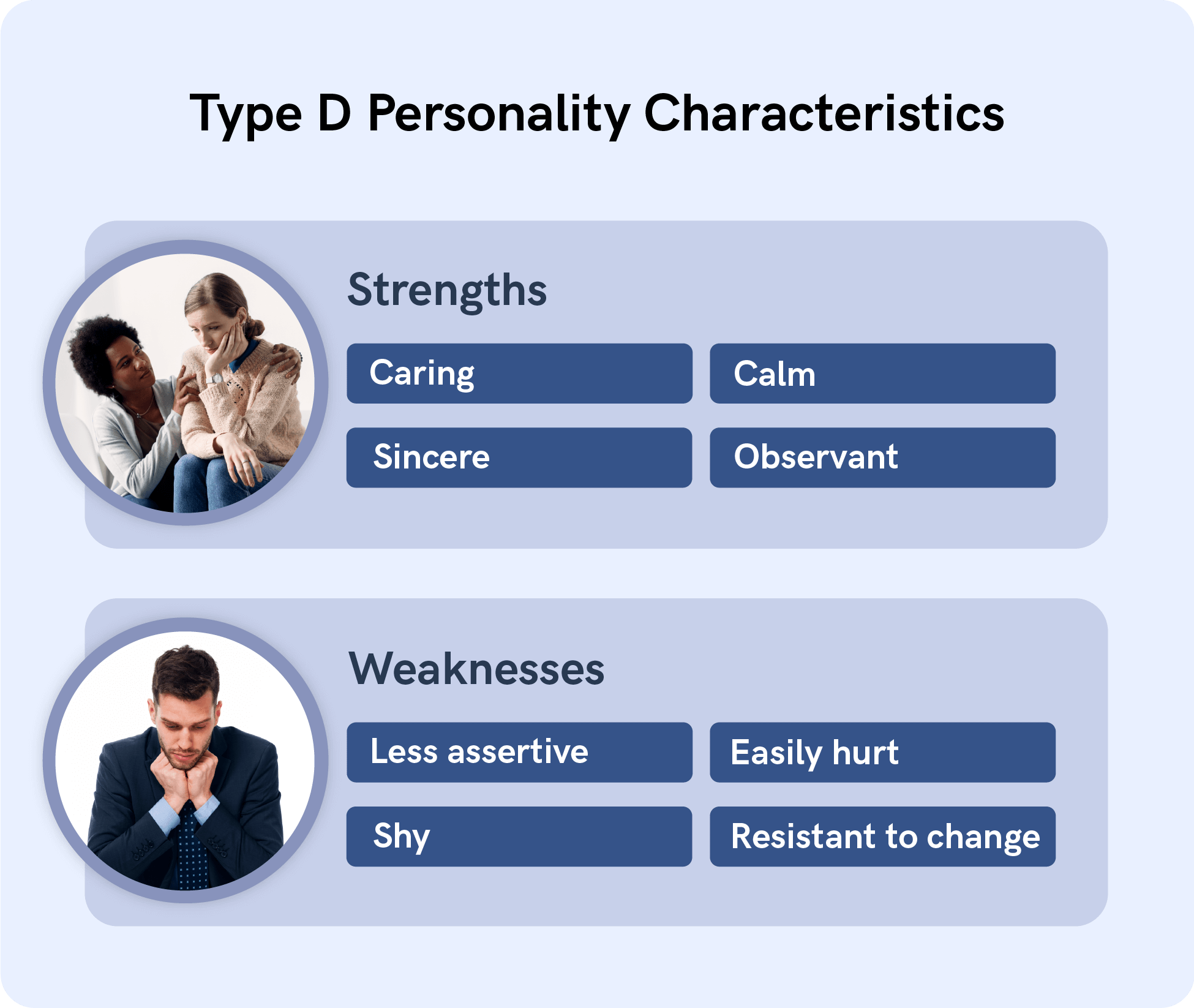
The Type D personality proceeds at a slower, safer pace in their work and personal lives. They seek security and longevity and find comfort in routine. Type D personalities dislike change and tend to keep to themselves as opposed to engaging in social situations.
Type D personality traits
As with the previous personalities, you'll find plenty of variation with Type D people. The best example of a Type D personality is someone who is:
- Shy, low-key and observant
- Caring
- Sincere
- Consistent, dependable
- Calm and stable
- Fair and equitable
- Looks approachable
- Avoiding confrontation
- Resistant to change
- Self-confident
What are other names for the Type D personality?
| Personality Tests & Approaches | Type D Personality Name |
|---|---|
| The Hire Success® System | Supporter |
| Hippocrates | Phlegmatic (bodily humor: phlegm) |
| Plato | Philosopher |
| Jung | Feeler |
| DISC | S; indirect/supporting |
| Insight | Orange |
| Myers-Briggs | ESTP, ESFP, ISTP, ISFP |
| Enneagram | Peacemaker/observer |
| PSI | Supporter |
| Biblical character | Abraham |
| Cartoon/comic characters | Charlie Brown (from Peanuts) / Winnie the Pooh |
How to test Type D personality
Because Type D personalities are anything but easy going, finding out what makes them tick can help you get the most from hiring this type. While they're highly trustworthy, compassionate, and deep thinkers, they can suffer from low self-confidence and pessimism. The Hire Success® Type D personality test will help you find the right place for them on your team.
Type D personality at work
People with Type D personalities can typically be identified by the following traits:
- Task-oriented
- Stabilizing
- Cautious
- Going along when they don't agree
- Easily used by others
- Uncomfortable with constant change
- Good at routines or repetitive tasks
They seek the respect, sincere admiration, and acceptance of others. The Type D personality will gladly work hard to please the people they work for as long as they feel appreciated and receive plenty of reassurance that they're needed. They need that sense of security. Type D personalities often think the Type A personality is crazy for taking so many risks and not showing much concern for security and longevity.
Pros and cons of hiring Type D personality
People with Type D personality traits are usually very organized; being around a messy environment or disorganization will bother them. They're also good at playing a very supportive role with others and are normally very caring, thoughtful, and compassionate. They're patient, tend to be good listeners and will persevere when all others have given up. A stabilizing force, they especially like working in a group or on a team.
Although they may not be as fast as others, they're accurate and thorough. They'll usually keep their feelings to themselves and are reluctant to express themselves, even if a more assertive type seems to be taking advantage of them. They tend to go along with anything.
To attract the Type D personality in a job ad, be sure to talk about the company benefits package and the long-term growth potential within the company. Having a secure, stable environment will be very important to Type D personalities.
How to deal with Type D personality at work
Managing a Type D personality takes some finesse. You cannot let their natural pessimism and social comfort issues bring down the team. Their hard-working nature, compassion and honesty are valuable strengths. They're keen at observation and think things through, so they can be valuable at solving problems and reducing risk.
What motivates a Type D personality?
- Stability
- Benefits
- Security
- Low risk
- Routine
- Team/group opportunities
- Calm work atmosphere
What are some common words or phrases that motivate or grab the attention of the Type D personality?
- "Help others in need"
- Relaxed atmosphere
- Logical
- Rational
What are the turnoffs, dislikes, and fears of the Type D personality?
- Risks
- Pushy people
- Change (especially frequent change)
- Instability
- Disorganization
- Aggressive behavior
- Disruption in routine
- Surprises
- The unknown
- Conflict
Which jobs attract a Type D personality?
Considering the benefits they bring to your organization, the best careers for Type D personality include:
- Secure team position
- Administrator
- Financial services
- HR manager
- Social worker
- Bureaucrat
- Family doctor/nurse
- Assembly line worker
- Residential/community services
- Mechanic
- Teacher
- Counselor
- Personal assistant/secretary
- Minister
- Insurance agent
- Supervisor
- Librarian
- Security guard
- Customer service representative
What is a Type X personality?
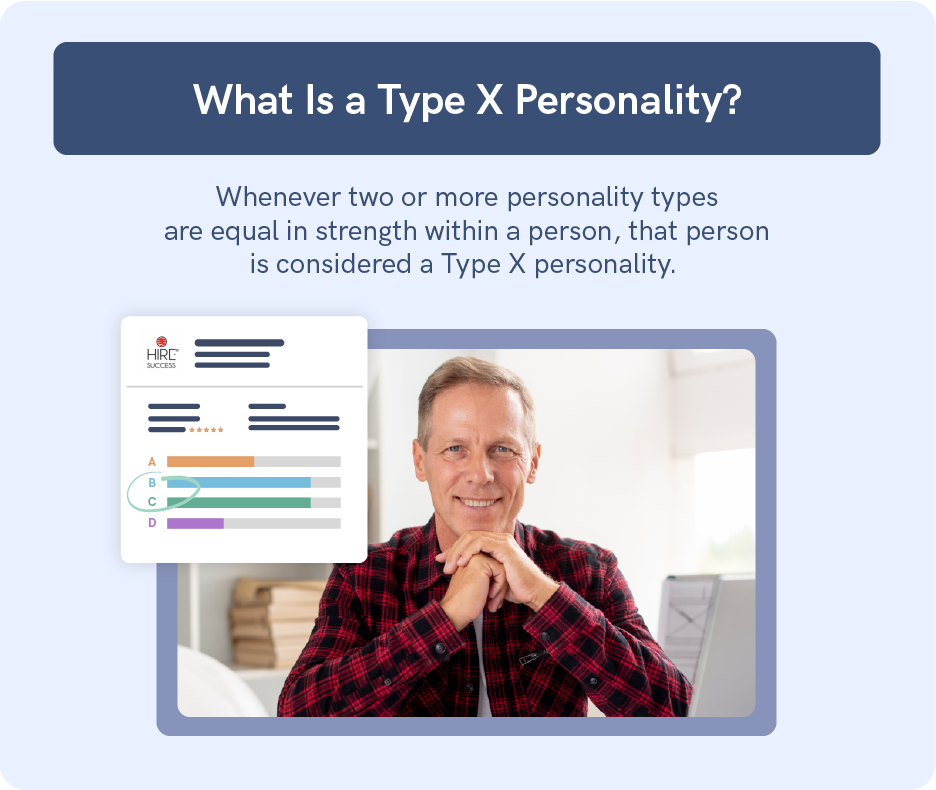
Whenever two or more personality types are equal in strength within a person, that person is considered a Type X personality. For example, if an individual's two highest-strength personality types were A and B, they might be identified as AX and BX. In the rare event that all four personality types were identical, that person would be considered simply as a Type X personality.
Type X personality traits
The X indicates a cross or an intersection of two or more types. It's not unusual to see the X between two of the four personality types, and it doesn't necessarily have to include the primary personality. However, when it does include the primary personality, the individual in question may have a tendency to be like one type in one situation and the other type in another. When all four temperaments are very close in strength, the individual may seem like a mixture of personalities.
This can be beneficial for many jobs, especially when it's important that the person gets along with almost everybody, such as consultative sales people. The Type X personality tends to change personality "colors" as needed based on their surroundings. Although unpredictable at times, this rare combination could be an important asset if fully utilized.
4 personalities vs. other personality type models
When it comes to personality type systems, you can have just four or five personality types or over sixteen combinations.
Unlike many other models, the Hire Success® system doesn't stop with four personalities or sixteen variations. The system also independently determines 20 different personality traits and doesn't base this information on what might be expected from a particular personality type. The inclusion of these expanded traits is one of the ways the Hire Success® system differs from other models, like Myers-Briggs®, and opens the door to highlight those differences that make the applicant a unique individual. Instead of attempting to fit individuals into a rigid box of the four basic temperaments, the system considers the spectrum of unique human traits that an applicant can have.
If and when you see a trait differ from what might be described in the personality overview, it's not a mistake. It's most likely the trait you can expect to see from the applicant on a day-to-day basis and not just an expectation based on a traditional personality description.
How Hire Success® uses the 4 basic personality types
The Hire Success® Personality Profile Test is a tool used to assess behavior in the workplace for job applicants and current employees to help identify an individual's personality type(s). Using a 5-point scale and a list of 100 adjectives, participants rate how frequently each adjective describes their behavior at work: "1" for often, "2-4" for varying degrees, and "5" for seldom.
Here's how the system works:
- Each applicant is instructed to respond to the Hire Success® Personality Profile form based on how they work. The results will indicate which of the four personality types they draw from most.
- The system automatically provides a description of the primary personality at the beginning of the Overview Report. Variations of the above will be printed if the test taker is a combination of more than one personality type, or a Type X. You can compare the results against the baseline you developed to help speed up your hiring process.
- In the Summary Report, a bar chart is provided along with a percentage, or strength, of each of the four personality types. The higher the percentage, the more dominant that personality type. When two or more types of personality are close, or the same, in strength, the applicant may be characteristic of both types.
These Type A, B, C, and D personality descriptions in the Hire Success® system provide context, but individual traits may differ from these general personality descriptions. This tool is designed to accelerate the hiring process by providing insights into an individual's behavior and personality fit for a given role.