
Using AI in the hiring process is changing how companies recruit and hire employees. It can streamline hiring workflows, screen candidates quickly and effectively, and reduce repetitive administrative tasks so that managers can focus their energy where it matters.
As powerful as AI in hiring is, it’s not a replacement for human involvement. Overreliance on technology can introduce bias into decision-making, lead to a lack of accountability, and create compliance problems. Nuance and judgment still require human attention and thought. However, with the right knowledge, it’s possible to use artificial intelligence in hiring in ways that strengthen your process while avoiding common pitfalls.
Key takeaways
- Using AI in hiring can support human judgment while improving speed, consistency, and the candidate experience.
- AI is particularly useful for performing repetitive tasks and supporting stages of the hiring process where there’s more risk of human bias and interpretation occurring, such as interviews.
- Standardized skills, aptitude, and personality tests can generate insights and data that AI can use to help inform human decisions.
AI in recruitment and talent acquisition
Companies using AI for recruitment across the hiring process have become mainstream, with almost 60% of recruiters currently using AI in talent acquisition.
AI is a valuable tool for supporting smarter use of resources. Using AI in recruiting lets companies scan networks and databases to source quality candidates, speed up the screening of resumes, and even schedule interviews and automate communications.
By taking over repetitive manual tasks, using AI in talent acquisition supports HR staff and hiring managers, helps build a stronger talent pipeline, and speeds up time-to-hire. New ways of using AI in the hiring process are emerging all the time.
Using AI voice agents to interview candidates
Artificial intelligence in hiring is bringing consistency to the interview process, having a measurable impact on both the candidate experience and early retention. One field study found that 78% of applicants chose an AI interviewer over a human recruiter when given the choice. Among more than 70,000 applicants, those hires who were initially interviewed by AI were also 17% more likely to stay in the role for at least 30 days.
The impact of AI on recruitment is far-reaching. Integrating AI technology and human decision-making is the best way to balance efficiency, fairness, and a positive candidate experience.
Invest in future performance, predict long-term fit
Use our personality assessment to identify candidates who will thrive in their role and in your evolving organization.
Book a Demo Try It Free
7 tips for adding AI to your hiring process
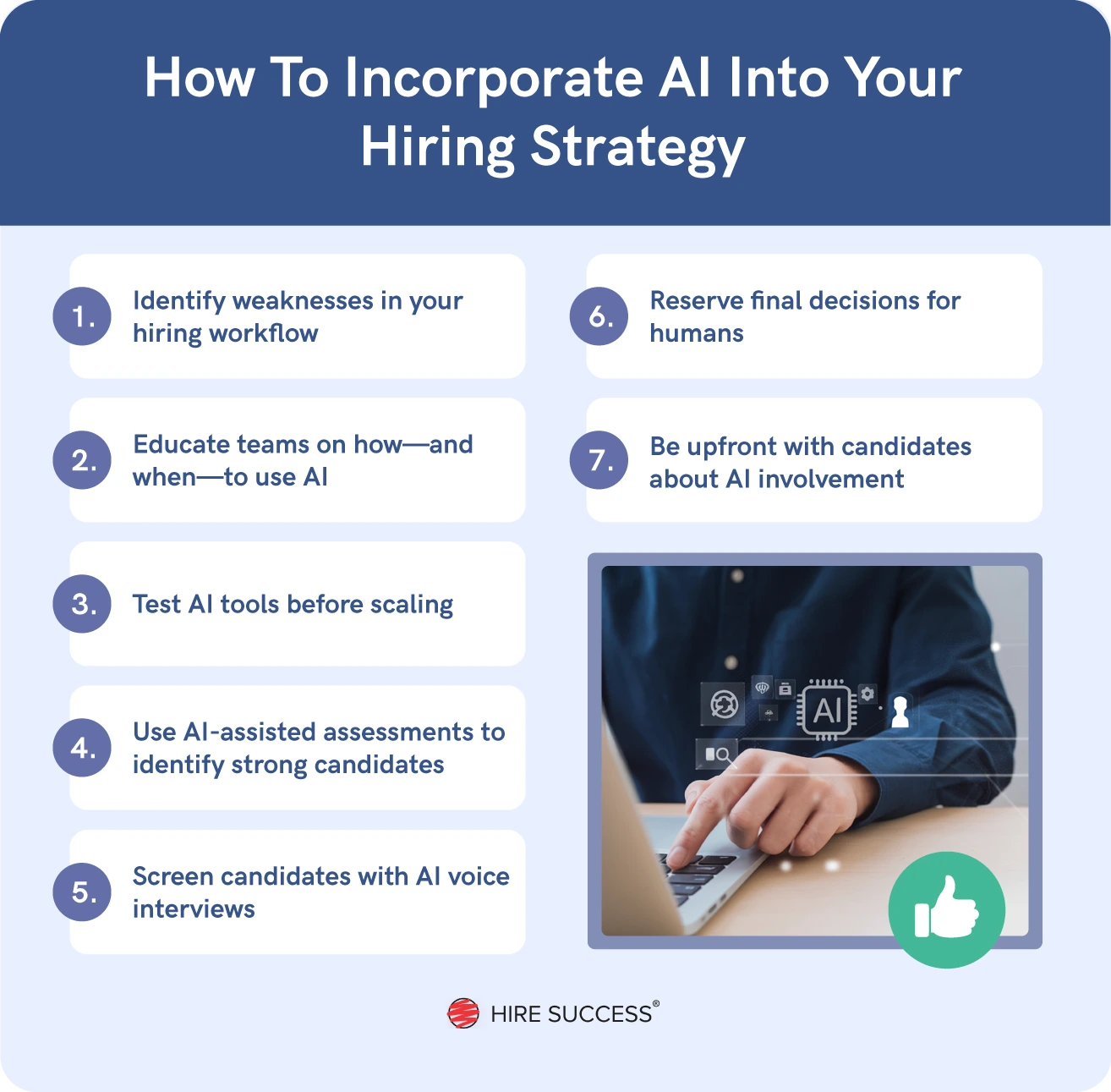
How is artificial intelligence changing the recruiting process? The answer depends on the company and how they’re using the technology. Companies using AI for recruitment most effectively make careful choices as to where and how to use it. The tips below can help reduce risk and strike the right balance between efficiency, fairness, and making good hiring decisions.
1. Identify any weaknesses in your process
Start by assessing your current hiring process and identifying problem areas and pain points. Common issues include job descriptions that are incomplete or unclear, slow hiring cycles, and candidate complaints about poor communication or bias. From there, you can then adopt AI in hiring in areas where it’s most useful.
2. Educate your team about AI limitations and use
People have different beliefs about the impact of AI on recruiting. Some have unreasonably high expectations, and others have unfounded anxieties. Currently, AI is far from perfect, and it cannot replace human thought and judgment. Educating teams about its capabilities, the risks of bias and over-automation, data quality, and best practices for using it can help manage expectations.
3. Start small and test out AI effectiveness
Overhauling your entire process to introduce AI in hiring is a costly and high-risk proposition. It’s better to approach using AI in recruitment with measured steps. Start with low-stakes and easy-to-implement applications, such as improving job descriptions, then test, measure, learn, and improve. Add AI to your process carefully, step by step.
4. Use pre-employment tests to identify top candidates with AI assistance
Use pre-employment tests supported by AI to efficiently identify candidates who have the skills, abilities, and personality to succeed in a role. These assessments give you objective and comparable data across candidates that AI can use to highlight patterns, suggest interview questions, and prioritize the most promising candidates. Using AI in the hiring process in this way can enhance each step.
5. Use AI voice agents to interview candidates
The research on AI voice agents we detailed above shows that many candidates prefer an AI-led interview experience. The reasons candidates gave for this choice were convenience and a more consistent experience. Using AI in talent acquisition in this way is most useful for high-volume hiring where speed and standardization count.
6. Avoid using AI to make final decisions
AI is a useful tool, but it cannot replace the human element. It can improve the hiring process, but decisions should ultimately be made by people. The subtleties of context, culture, and fit with an organization's values are all areas where AI algorithms simply fall short. Relying exclusively on AI in recruiting exposes you to legal and ethical risks.
7. Be transparent with job applicants about AI use
Be upfront about how your organization uses AI. Let candidates know where you are using AI in the hiring process to build trust and protect your organization. Set clear rules and expectations for job candidates. Clearly outlining ethical uses of AI can help prevent AI cheating by applicants.
The pros and cons of using AI in recruitment
AI is increasingly playing a larger role in the recruiting and hiring process. Using AI in hiring improves an organization’s ability to find, screen, and engage high-quality job candidates. That said, the impact of AI on recruitment has its downsides. As your organization adopts artificial intelligence in hiring processes, it’s vital to understand the benefits and risks.
Benefits of incorporating AI in the hiring process
Thoughtful and strategic use of AI in hiring can have dramatic, positive impacts on the effectiveness of your processes. The benefits include:
- Faster and more efficient hiring. Automating repetitive and time-consuming tasks can improve time-to-hire.
- Increased cost savings. As well as saving time, you can save money. Less work means fewer man-hours and lower costs.
- Better-quality candidates. AI tools can scour the talent pool to uncover more qualified candidates, especially those who might be overlooked by manual methods.
- Improved consistency. From screening to interviewing and testing, AI can create a fair process for everyone, without the variability that can lead to suspicion.
- Better candidate experience. Fast, clear, and accurate communication, easy interview scheduling, and a transparent process make for a good candidate experience.
- Enhanced data-driven decisions. Rather than relying on gut feel, hiring managers can use quantifiable and comparable information. The whole process can be tracked and measured to identify ways to improve hiring and outcomes.
Is it ethical to use AI for hiring decisions?
Ethical concerns related to companies using AI for recruitment are very real. Algorithms can embed bias into the process if there are any inequities in the training data, which will be reinforced in practice. That said, human decision-making is also prone to bias, and using AI in the hiring process with care and an awareness of the risks can help to mitigate some of the negatives. Relying on AI exclusively isn’t necessarily unethical; however, it can be unwise. Using it as a tool to support human decision-making strikes a better balance.
Stay ahead: Rely on assessments more than AI
AI holds enormous promise across many parts of the hiring process. In areas where human bias and subjective perceptions limit the hiring pool and may lead to poor decisions, AI can help. AI works best when paired with standardized skills, aptitude, and personality assessments. It can use the objective and comparable measurements these assessments produce to identify those candidates that potentially best fit the job. Current best practices suggest that using a combination of testing, AI, and human decision-making in your hiring can help you achieve optimal results.