
How to prevent AI cheating in hiring has become a hot topic. Artificial intelligence is changing the hiring process on both sides. This is beneficial in some ways and in others not. For instance, AI in job interviews poses a problem when job candidates use it to prepare in ways that make it easier to misrepresent their skills and experience.
Hiring managers need to ensure that applications and interviews convey an accurate view of a candidate. Companies are increasingly turning to skills-based assessments as an option for dealing with AI cheating in hiring. You can use these tests to independently assess candidates’ abilities and validate their qualifications.
This article explores practical strategies to prevent job candidates from cheating using AI.
Key takeaways
- Both employers and candidates use AI in the hiring process. While it can be helpful, the danger of using AI to cheat is growing.
- When candidates use AI to mislead interviewers during hiring, the risk of hiring the wrong person skyrockets.
- Skills-first hiring and the use of secure, proctored testing platforms add integrity to the process, so you can objectively verify and measure real capabilities and stop AI cheating.
The rise of AI usage in hiring
AI use is rising in the hiring process. Companies can use it to screen resumes, automate interview scheduling, and even analyze interview transcripts for language, tone, and critical information. It can help you manage a large pool of applicants with efficiency, consistency, speed, and insight that would be impossible to do manually.
In contrast, job candidates can use AI to tailor their resumes and write cover letters that check all the boxes. They can also use it to polish interview responses and suggest questions candidates can ask during interviews.
The problem is when ethical lines blur in using AI for job interviews. When does polishing slip into misrepresentation? Particularly when conducting interviews remotely, it is harder to determine if a candidate is speaking from experience or from an AI-created script. The risks of hiring the wrong person who lacks the necessary skills and experience are higher with the use of AI, as is the cost to your business.
How job applicants use AI
When you understand how a job applicant uses AI in beneficial ways, it can help you spot the times when they are cheating using AI. Before you put measures in place to stop AI cheating, here are some ways candidates are using AI for job interviews and in the hiring process.
- Job research. Applicants can use AI to find job openings and tailor their searches to find the best opportunities.
- Resume or cover letter creation. Job applicants can also use AI to tailor their resumes and cover letters to fit the job post and description.
- Job interview preparation. A candidate may use AI to construct answers to interview questions and rehearse them before an interview.
- Real-time virtual interview assistance. It becomes more ambiguous when candidates use AI apps that work as an "interview copilot” to suggest responses in real time as they participate in an interview.
- Using deepfakes or impersonation. Using AI to actually cheat involves using representations that make it appear an applicant is participating and that they have the required skills and background.
Move beyond resumes, identify true potential
Make smarter hiring decisions using objective data on candidates' strengths, work styles, and personality traits.
Book a Demo Try It FreeAt what point is AI usage considered cheating during a job interview?
First, it is important to define where AI help crosses the line into cheating using AI. Identify what is allowed and what is prohibited, and then you can focus on how to prevent AI cheating in hiring.
Responsible use of AI for research and interview practice is acceptable. Using AI for job interviews becomes cheating when the candidate’s goal is no longer presenting themselves accurately but deceiving the interviewer. Candidates who use AI for answers undermine the purpose of the job interview. Instead of an applicant sharing their expertise and thinking, they are misleading the interviewer with a false presentation of themselves.
Use skills-first hiring for talent acquisition
Employers are moving toward skills-first hiring, which objectively measures and assesses the abilities of a candidate. Rather than depend on years worked, jobs held, and degrees earned, hiring managers can test actual skills. This smart hiring strategy helps employers find better quality hires from a more diverse talent pool. It is also effective in preventing AI cheating in hiring processes.
How to prevent AI cheating during job assessments
Skills testing is an example of how to deal with AI cheating. As more employers add formal assessments to their interviews, candidates may be increasingly tempted to cheat. Job candidates have been caught using AI in skills testing by opening browser tabs or using a second device to look up answers. Determining how to prevent AI cheating in hiring assessments requires adopting a multi-layered approach to protect your process.
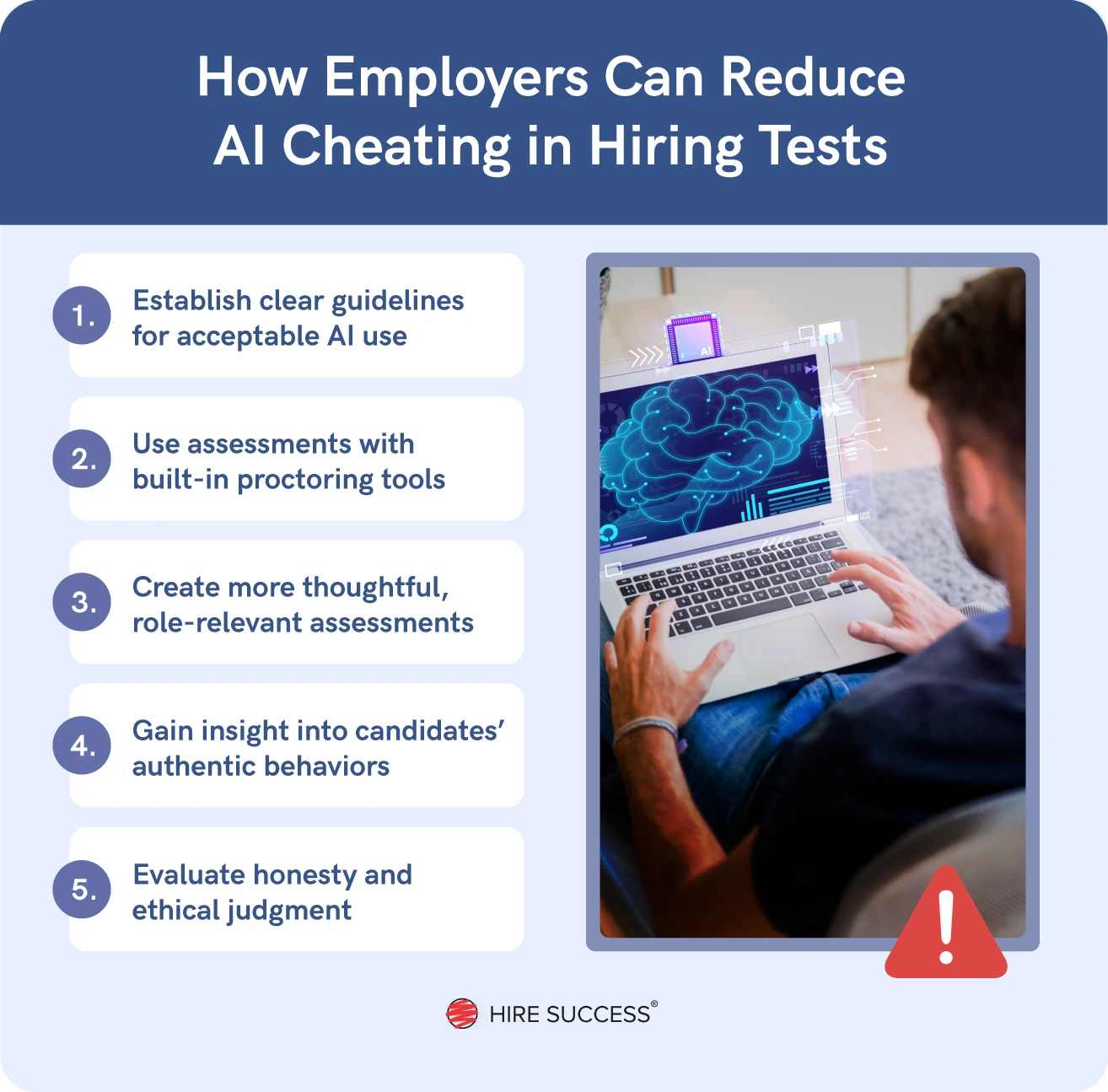
1. Set clear rules for how candidates can use AI
Tell candidates what is acceptable as to how using AI for job interviews works. Spell out what AI cheating is in hiring to deter candidates from misusing AI. Having clear rules upfront makes upholding enforcement more straightforward should you find applicants caught using AI in unethical ways.
2. Use tests with proctoring features
Proctored pre-employment testing platforms are another way to stop AI cheating in hiring. The best of these systems detect behaviors that might indicate cheating, such as tab switching, extended inactivity, making multiple attempts to take the test, or suspicious patterns that indicate the use of AI. The Hire Success® proctored platform has cheating mitigation features that give you confidence in the results so you can make an accurate assessment of each candidate.
3. Design smarter assessments
A well-designed assessment makes it harder to cheat. Add custom questions relevant to your business, tools, and workflows to help design a smarter candidate assessment. For example, getting AI to answer a question about how to handle a specific customer issue with your distinct CRM will not generate an insightful result, leading to an answer you can easily flag as AI-created.
You can also incorporate scenarios and tasks that require an applicant to apply their knowledge rather than revert to a memorized or AI-created answer. Use a mix of multiple-choice and short-answer questions to uncover genuine understanding. The Hire Success® Custom Test Builder makes it easy to design assessments that fit the demands of your job opening and defeat AI cheating.
4. Understand candidates’ true nature
The ideal candidate is more than a resume and set of skills. To thoroughly assess each applicant and the likelihood they will fit within your organization and culture, add personality assessments. The most effective teams include people with a mix of traits and work styles. You want to know how someone will approach a job, behave at work, handle pressure, and make decisions.
Combining personality with skills tests can uncover more insight than you could get from a technical answer. You can integrate both personality and skills tests using the Hire Success® Custom Test Builder.
5. Measure honesty and integrity
Honesty in your employees is vital to your culture, teams, and business. You can train people in skills, but integrity must be fundamental to who they are. Add integrity assessments that uncover potential red flags around accountability, rule-breaking, misuse of resources, and general dishonesty.
Going beyond how to prevent AI cheating in hiring, these tests reveal job candidates who may be prone to unethical behavior. Assessments help you cultivate successful hires and protect your teams and company reputation from the cost of a bad hire.
The importance of reliable hiring technology in the age of AI
Technology is what powers AI cheating in hiring. However, it is also a valuable tool in understanding how to prevent AI cheating in hiring.
It is a proven fact that AI aids in efficiency, speed, and increased hiring effectiveness. Yet when it comes to understanding people, automated systems are limited. Algorithms carry bias, creating ethical concerns. In addition, automation used alone as a “black box” takes the transparency out of decision-making and dehumanizes the hiring process, creating an accountability gap. You may also open your organization up to privacy issues in collecting large amounts of data.
Human judgment remains the cornerstone of hiring the right people. The careful choice of legal pre-employment technology used properly and paired with effective testing can demonstrate fairness and establish trust. Done right, you can balance the advantages of technology with the human element of intuitive judgement. Establish transparency around your expectations for adding AI in your hiring process to enhance trust with candidates. AI has a valuable role in the hiring process when you eliminate the potential negatives.