
A well-structured hiring process is a powerful tool for attracting and bringing on the best talent. The market for good employees is competitive. Having a clear hiring timeline and defined steps in the professional candidate experience lowers the risk of losing qualified people to faster-moving competitors. At the same time, you can lower recruiting costs, shorten the time to fill positions, and make better hiring decisions.
Your time to fill is unique to your industry and company, with some variation by role. A typical hiring process timeline starts with the job posting and ends with a final offer. If done well, the recruitment timeline keeps hiring teams organized and on track, gives managers time to compare candidates effectively, and keeps job applicants informed and engaged along the way.
Key takeaways
- A clear, well-structured timeline for hiring speeds things up, improves the candidate experience, and keeps costs down.
- Optimize the timeline with clear, realistic benchmarks, week by week, and align hiring managers around them.
- Consider company size, the nature of the job, and your internal processes in finding ways to expedite hiring.
- Automate screening and evaluation with objective measures that support faster, better-informed hiring decision-making.
What's the average hiring process timeline?

The hiring process timeline for your company may take three to six weeks, or even several months. Answering the question of how long the hiring process is depends on the job you are filling, the industry, and the unique needs of your organization.
On average, the hiring process takes 54 days from opening a requisition to a candidate accepting an offer. Filling executive roles can take longer. In today's hyper-competitive environment, it is vital to figure out how to speed up hiring. Making good decisions faster prevents losing a high-quality hire to a competitor. A hiring process flowchart and step-by-step checklist will help you create a more effective hiring timeline.
Week by week breakdown of the hiring timeline
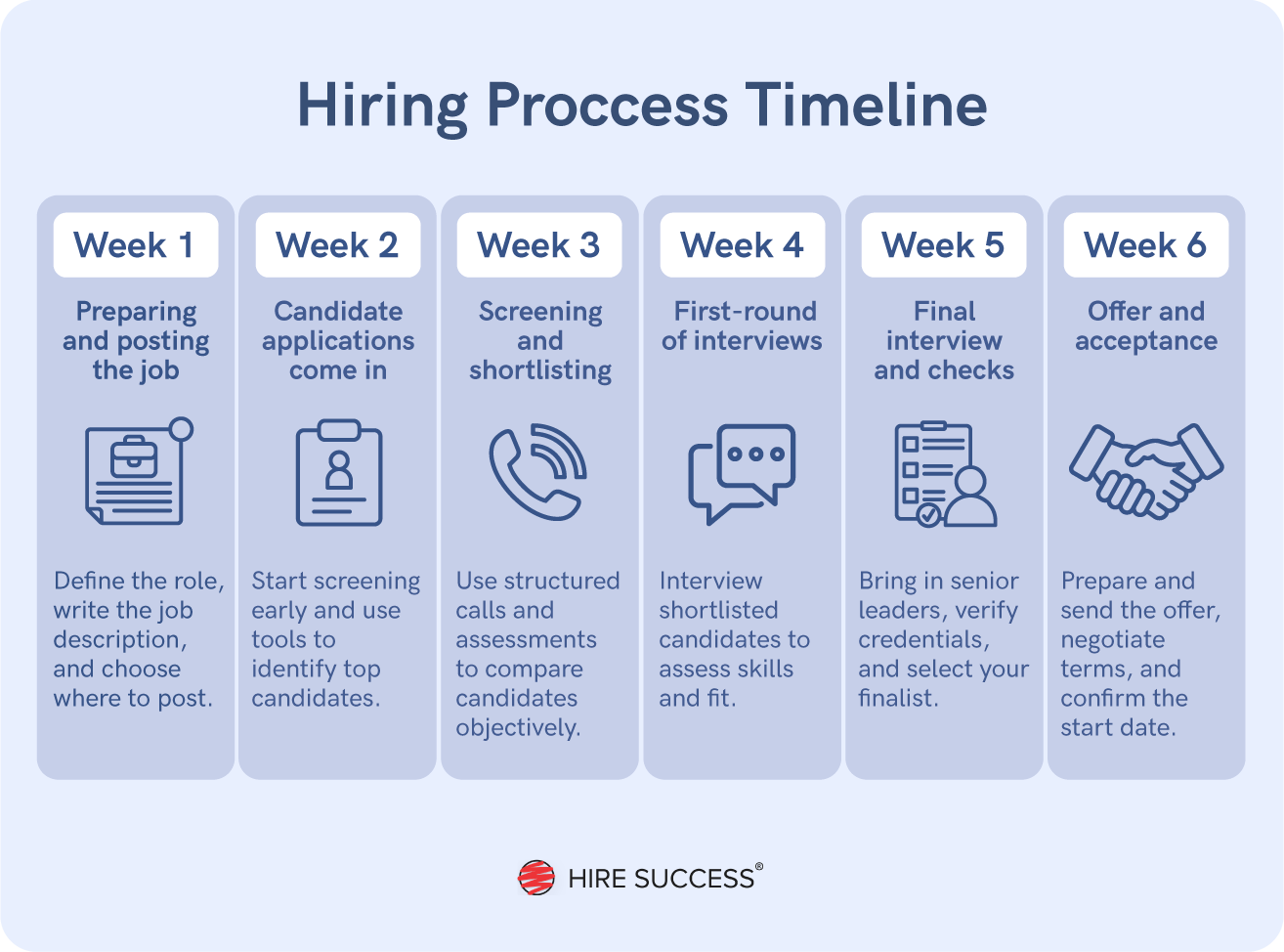
Break your interview process timeline into clear weekly milestones and make sure hiring teams know the details. Work with them to identify and eliminate bottlenecks. Ask: How long does the hiring process take now? Then look for ways to streamline it. Use the following week-by-week framework as your starting point, and then adjust it based on your company, industry, role, and recruiting environment. You can refine it and add detail by referring to our hiring process checklist.
Week 1: Preparing and posting the job
Identifying the specifics of the role, writing a job description and needed qualifications, and getting the necessary approvals are the first steps in the typical hiring process timeline. You will want to look at which channels will give you the best pool of qualified candidates.
Many companies use a combination of job boards, recruiters and agencies, their own websites and social media properties, and employee referrals. You will need to write the job ad and post it to get the ball rolling. It typically takes 2 days from approval to get a job opening posted.
Week 2: Candidate applications come in
Applications start arriving almost immediately after a job is posted. You'll want to start actively screening and developing your candidate shortlist as soon as possible. Companies typically start this process 5 days after posting the ad.
The challenge is quickly finding the best people from a large volume of applications. You can boost the effectiveness of your process with tools that automate pre-screening and pre-employment testing, like those offered by Hire Success®. Only 27% of organizations automate pre-screening, which gives them a competitive edge. Moving faster than competitors with a quick, consistent, and effective process engages top candidates and creates a professional impression.
Move beyond resumes, identify true potential
Make smarter hiring decisions using objective data on candidates' strengths, work styles, and personality traits.
Book a Demo Try It FreeWeek 3: Screening and shortlisting
Evaluating applicants to find the ones with the qualifications that best meet your requirements is a critical step. Companies use a variety of pre-employment screening methods. Structuring phone interviews and using standardized assessments that give you an objective way to compare candidates will help you use your valuable interview time only on those candidates most likely to succeed in a role.
The average screening time is five days; however, this phase of the process can easily bog down. The average time to fill a role from this step forward is around 36 days. With practical and efficient screening methods, you can shorten your recruitment timeline.
Week 4: First-round of interviews
By this time, you have a shortlist of candidates. Hiring managers will then conduct interviews to ask about skills and past performance, and to assess personality and cultural fit. Most companies, about 79%, conduct these interviews in person. Don't leave this step to chance.
Use a well-thought-out, structured interview to fairly and accurately capture information from each candidate. The way questions are framed is essential in developing effective interview questions. 34% of organizations use the structured interview approach, giving them an edge in finding the right candidate.
Week 5: Final interview and checks
Some roles require more than one round of job interviews. You may need to bring in senior leaders and cross-functional stakeholders. Then comes the work of selecting the best candidate from the short list. Interviewers may compare notes, evaluate pre-employment test results, and conduct background checks. Verifying employment qualifications and credentials, as well as obtaining necessary clearances, also occur at this stage. You should end this stage with a finalist and two backup candidates.
Week 6: Offer and acceptance
The final stage of the hiring process is preparing and making a formal job offer to the top candidate. You may need to negotiate the salary, start date, and benefits package. With an effective process, the average acceptance rate is 90% for nonexecutive hires and nearly 100% for leadership roles. Ideally, you can start the onboarding process right away to expedite the start date.
What factors affect how fast a position is filled?
How long is the hiring process for your organization? The answer depends on several factors. Considering the following issues can help you find ways to speed things up without sacrificing quality or adding risk. For a realistic recruiting timeline, think through these aspects:
- Company size and structure: If your organization is larger, you may have to work through more approval layers and coordinate across more departments. Smaller companies can often move faster.
- Complexity of the job role: Hiring for senior positions carries higher stakes due to fewer qualified candidates. For specialized and complex roles, you may encounter similar challenges in sourcing and evaluating candidates.
- Company's internal processes: Consider your screening and interviewing process and how your team selects the best candidate. You may be able to use tools and approaches that speed things up.
- Number of applicants: If you have a high volume of applicants, manually reviewing, screening, and shortlisting candidates takes longer and is harder to do well.
Tips for improving your hiring timeline
Decreasing the time it takes to hire in your company is essential in a competitive job market. Shortening your hiring timeline and reducing the time it takes to fill a position ensures you don't lose the best people to a slow process.
Some tips for trimming the typical hiring process timeline start with looking through the steps your organization takes. Can you eliminate any of them? Can you streamline some of them? You might reduce the number of interview rounds. You can automate scheduling. You can also use standardized screening criteria. Look for ways to improve communication between those doing the recruiting and hiring managers.
Make the best use of tools that can expedite and automate critical steps. Hire Success®'s pre-employment testing software, with objective candidate scoring, can help you quickly find the best matches early in your process. You can save time while also making smart, data-driven hiring decisions that lead you to the strongest hires for long-term success.